




Recent Publishing Transactions
It’s been an active season for publisher RFPs! We are grateful here at C&E for the opportunity to have supported numerous societies and associations as they evaluated publishing partners and negotiated new publishing services agreements through competitive selection processes. We are honored to have worked alongside the following organizations as they charted the next chapter of their publishing programs:
- American Ceramic Society
- American Political Science Association
- American Society of Criminology
- Phycological Society of America
- Radiological Society of North America
- Society for Investigative Dermatology
C&E at ACCESSE26
Pam Harley will be attending ACCESSE26, the annual conference for STEM society professionals hosted by CESSE, July 13–15 in Raleigh, NC. If you’ll be there, we’d love to connect. Please reach out to Pam directly at pharley@ce-strategy.com.
Colleen Scollans at EMUG2026
At the 2026 Editorial Manager User Group (EMUG), Colleen Scollans delivered the opening keynote on data harmonization and AI in scholarly publishing. Colleen made the case that submission and peer review systems are now critical AI infrastructure — and that data harmonization is essential for publishers operating in an AI-driven environment. Watch the recording on Vimeo — Colleen’s keynote runs from 3:38 to 28:09 (approximately 25 minutes).
Power Grab
The US Office of Management and Budget (OMB) has proposed extensive changes to the way federal dollars are spent on science. As FASEB CEO Darla Henderson observes, writing in The Scholarly Kitchen:
The proposed OMB rule is a 412-page-long significant rewrite of the guidance governing all federal grants and cooperative agreements, and proposed changes would apply to Fiscal Year 2027, starting October 1, 2026. These are not minor changes — the proposed rule entirely reworks the concept of federal grants. Changes span 456 sections of the regulations, with 52 new subsections and 375 reworded sections. The rule would impact the entirety of government grant-making across the United States.
Writing in Science, Editor-in-Chief Holden Thorp summarizes the changes:
The sweeping new regulations proposed by OMB would subject every federal research funding decision to political review. Peer review has never been formally binding, but this proposal would dramatically expand the power of political appointees to override expert assessments of scientific merit. Agencies could end multiyear grants with no due process. They could also use the vague criteria of Trump’s “gold standard science” to identify institutions for preferential treatment. International collaboration with countries identified solely by the administration would be prohibited under the new rules, but more notably, all research that involves the expenditure of funds outside the US would require case-by-case approval. This bureaucratic hurdle would effectively prevent most, if not all, partnerships from moving forward.
Thorp characterizes the proposed regulations as a power grab designed to wrest control of the way federal money is spent from Congress to the White House, spearheaded by OMB Director Russell Vought:
In any other administration, when Congress appropriates money for science each year, OMB’s job is to make sure that the funds are released in accordance with the law. But in Project 2025, the blueprint used by the Trump administration to overhaul the federal government according to a theory of greater executive power, Vought called for an activist OMB that serves as the “keeper of ‘commander’s intent,’” thereby moving power away from Congress.
Writing in STAT News, David Skorton, President and CEO of the Association of American Medical Colleges, warned the proposal “could end America’s scientific progress and leadership.” The New England Journal of Medicine has deemed the proposal “Lysenkoism” and warns that “…allowing politics to control the scientific process can halt or even reverse a nation’s progress. Erratic funding would fundamentally undermine innovation and dramatically impair America’s ability to address today’s health challenges.”
In addition to injecting partisan politics into scientific enterprise, the proposed rule changes would prohibit the use of federal grant funds for conference expenses (e.g., attendance at scientific meetings) or professional society membership fees without prior agency approval. Use of federal funds for publication fees would be prohibited except on a case-by-case basis requiring agency preapproval (or statutory law). Use of federal funds for journal subscriptions would be entirely prohibited. (Elizabeth Ginexi, a former NIH program officer, has written a helpful summary of the proposed key changes.) The prohibition on publication fees may be a response to the fact that many publishers are requiring that federally funded research be published via gold OA routes — with associated publication fees. This is a result of the Nelson Memo requiring free access to federally funded research with zero embargo. As we discussed last month in The Brief, most agencies have not budgeted for these publication costs. If the Nelson Memo remains in place (the White House Office of Science and Technology Policy is reportedly considering rescinding the memo) and the OMB rule change goes into effect, it is unclear how federally funded research will be published outside of the (relatively small) subset of subscription-based journals that allow green OA.
One possibility is that US universities pick up the tab by signing more transformative agreements. Another possibility — if the Nelson Memo (and the requirement for immediate public access) is rescinded — is that the US shifts back to a reliance on subscription publication (where universities already shoulder the costs). In either case, this appears to be an attempt to shift the cost of federal policies to universities — a strategy borrowed, perhaps, from observing the results of Plan S in Europe, which successfully shifted the costs of research funder policies to universities and national consortia.
As of this writing, there are over 38,000 public comments submitted in response to the OMB rule change. If your organization has not submitted a public comment, Henderson’s Scholarly Kitchen article (referenced at the top of this story) has excellent guidance on preparing a comment. The number of unique comments matters, as OMB must review and respond to every unique, substantive argument before issuing a final rule — we encourage every organization with a stake in scientific research and science publishing to submit a comment.
Wiley Acquires Emerald
Wiley has a soft spot for English publishers. The acquisition of Blackwell Publishing in 2007 was a major milestone in Wiley’s long publishing history. The purchase of the London-based (though historically Egyptian) Hindawi did not go as well, but that has apparently not soured Wiley on the country’s publishing houses. This time, Wiley has ventured all the way up to the northlands of Yorkshire to acquire Emerald Publishing from Cambridge Information Group.
The Emerald acquisition brings 485 journals, 8,000 books, and a substantial library of case studies to Wiley. Emerald’s roots are in management and business publishing, although it has expanded into other disciplines (finance, economics, engineering) over the years. (Emerald started out as Management Consultants Bradford before, wisely, changing the name of the company to the more subject-agnostic Emerald Publishing.)
Wiley paid $452 million for the Yorkshire publisher in an all-cash deal, which represents a 5.3x multiple on Emerald’s projected $85 million in revenues. Wiley, in a helpful Supplemental Investor Presentation on the deal, pegs the deal to a 7x multiple of “adjusted EBITDA including cost synergies”. Without seeing detailed financials, it is hard to evaluate this figure. A 5x multiple on topline revenue, however, is a healthy but entirely reasonable figure given there are simply not many publishers of Emerald’s size and reputation to acquire.
For comparison, Wiley paid a more exuberant 7x multiple of topline revenue for Hindawi, a company that had very little (if any) recurring revenues. Emerald, by contrast, brings a portfolio with strong recurring revenues: Emerald’s journal portfolio is largely subscription-based. According to Dimensions, 79% of Emerald’s journal portfolio was subscription-based (not OA) in 2025.
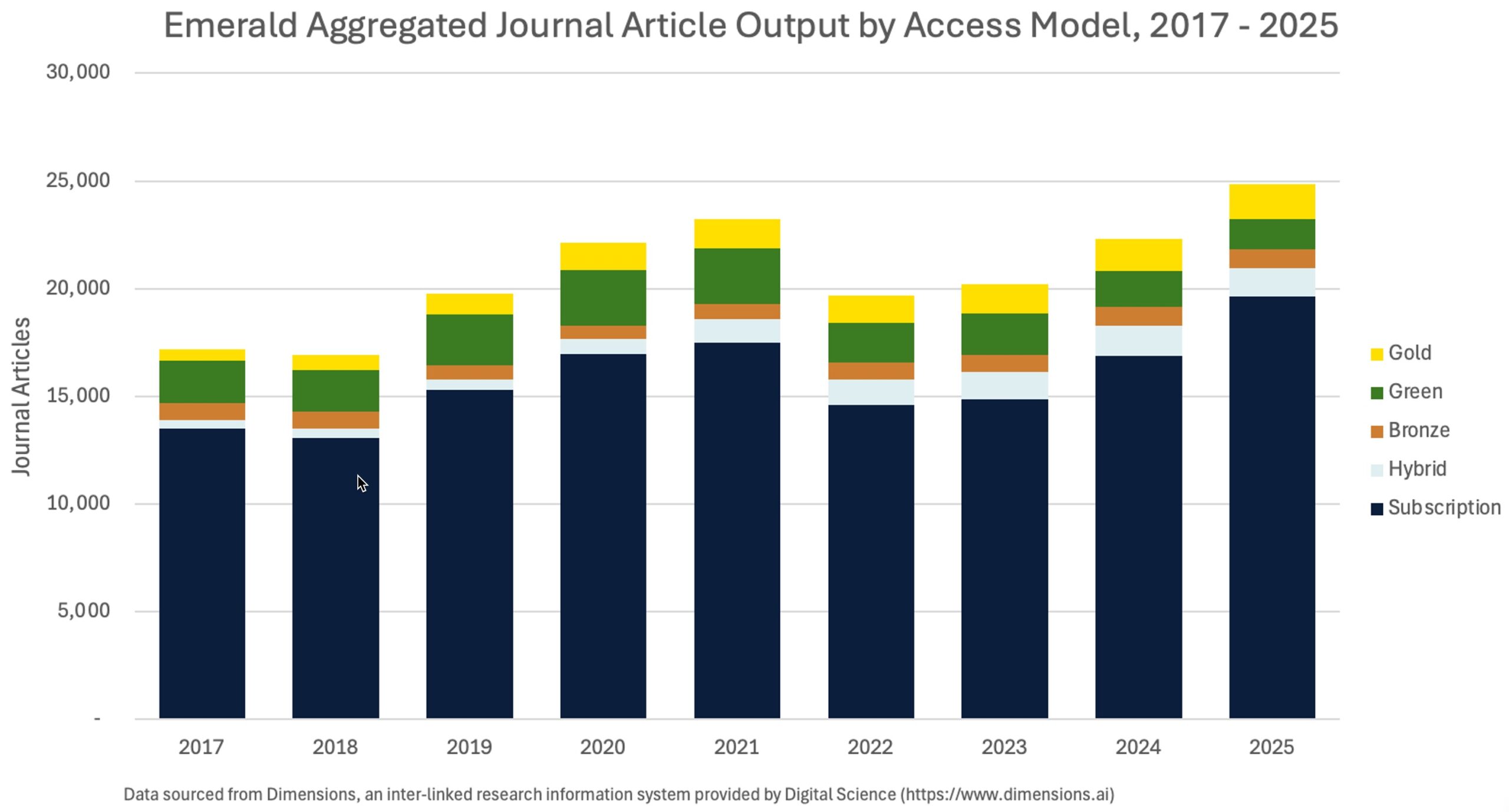
It is also well-diversified geographically, with 85% of Emerald’s revenues deriving from outside North America.
Wiley believes that it will find $30 million in efficiencies “through the integration of Emerald journals into Wiley’s online platform and publishing operations, as well as the elimination of duplicative costs.” This figure seems eminently reasonable. Given that Wiley already publishes in the same areas as Emerald (business, management, finance, economics, engineering), Emerald’s books and journals should slide right into Wiley’s publishing systems and operations. (Our sympathies to the team at Emerald who just migrated the Emerald portfolio to the Silverchair platform, given the stated plans to now migrate over to Wiley’s Atypon platform.)
In addition to the operational efficiencies, Emerald’s relatively small market penetration in North America presents a revenue growth opportunity given Wiley’s strong sales operations in its home territory. Wiley did not even mention this relatively obvious upside potential in their Supplemental Investor Presentation. The presentation instead positions the acquisition as strengthening Wiley’s “AI Growth Flywheel.” (Before your eyes roll all the way into the back of your head upon hearing what may be the ultimate example of MBA-speak, remember this is an acquisition of a management and business publisher so this sort of lingo goes with the territory.) Fortunately, we here at The Brief are management consultants so we can translate what (we think) Wiley means by this salad of buzzwords and associated diagrams.
Wiley has developed AI licensing infrastructure (as reported previously in The Brief). In particular, Wiley’s AI Knowledge Nexus provides sales infrastructure for AI licensing of Wiley’s own proprietary titles as well as participating society partners and other publishers. AI Knowledge Nexus is focused on the corporate market and especially corporations with substantial R&D functions. (We should note that Wiley is not the only publisher to develop such infrastructure — though it is, to our knowledge, the only publisher that has extended its service to include the portfolios of other publishers.) The idea is that Wiley licenses content sets for inclusion in the private (non-public) AI tools and associated databases employed by corporate R&D teams. Wiley appears to be saying that by licensing to such teams, more research will be produced, which produces more publications, which in turn provides more to license (the “AI Growth Flywheel”).
The flywheel concept flies apart for us given that corporate R&D departments are notably sparing in writing up papers based on their research activities. But the flywheel does not seem essential to Wiley’s acquisition thesis; it overcomplicates the straightforward case that Emerald will help Wiley grow more revenue from AI licensing activities. As noted above, Emerald’s journal portfolio is largely subscription-based. That means most content is behind a paywall and can’t be (either easily or legally) hoovered up by AI tools. The Emerald portfolio adds to Wiley’s heft in terms of corporate R&D licensing deals (in particular, with companies in banking, financial services, industrial manufacturing, and food & agriculture) as well as licensing deals with the makers of foundation models (Google, Microsoft, OpenAI, Anthropic, etc.).
It also adds more content into Wiley’s Scholar Gateway play, which bets that researchers will increasingly access content through AI tools like Claude, Mistral, and ChatGPT. Wiley AI Gateway is the infrastructure that makes this possible — authenticated users can access their institutional subscription directly inside the AI tools they’re already using (a model referred to as BYOL, or bring your own license).
Indeed, Wiley has some growing momentum in AI licensing to support its acquisition thesis. The company’s just announced FY 2026 results indicate growth in AI revenue of 23% (year-over-year) to $49 million and suggest that a growing proportion of that is recurring revenues. Granted, the $49 million is in context of $1.1 billion in overall annual revenues for the Wiley Research group, but this is high-margin revenue from new sources and it is early days.
This deal adds additional clarity to Wiley’s emerging strategy for navigating the growth in AI technologies. Unlike Elsevier and Wolters Kluwer, Wiley is not focused on developing its own AI products (putting aside its Partner Solutions group). Wiley’s path appears to be to keep to the business it knows best: publishing high-value, professional content. Its overall bet seems to be that such content will remain valuable as AI tools proliferate and that it will be able to grow that value through licensing and economies of scale. So far, the market is rewarding this strategy. Wiley’s stock is up nearly 50% year-to-date as compared to RELX (Elsevier) and Wolters Kluwer, which are down 22% and 37% year-to-date, respectively (we discussed the divergence in strategy and market valuation between these publishers in the April issue of The Brief).
In summary, there is a great deal to like (for Wiley) in this Emerald deal. While a 5.3x multiple is healthy, it does not strike us as exuberant. Wiley has a clear and credible path to $30 million in operating efficiencies. There is also, in our view, a material opportunity to grow revenues related to the Emerald portfolio in North America. Emerald also strengthens Wiley’s fast-growing AI licensing business in attractive corporate segments as well as with foundation models. As compared to Wiley’s last major acquisition (Hindawi), Emerald presents far less risk. Emerald’s revenues are largely recurring and its subscription model focus insulates it from the acute research integrity risks that can accompany volume-based OA portfolios.
While the Blackwell acquisition was transformative for Wiley, and Hindawi might be viewed as character building, Emerald appears to be a smart and disciplined bet that builds in all the right ways on Wiley’s existing strengths.
Specialized Clinical Tools vs Frontier Models
In a recent paper published in Nature Medicine, researchers at NYU compared frontier, general-purpose LLMs (GPT-5.2, Gemini 3.1 Pro, and Claude Opus 4.6) to two specialized clinical AI tools (OpenEvidence and UpToDate Expert AI). The comparison spanned three stages, including 100 real physician queries from live clinical deployment. The frontier models outperformed the specialized clinical tools across the board by a wide margin.
The researchers suggest that the relative performance of frontier models may be due, in part, to the current level of investment pouring into them:
Frontier LLMs may simply be better at the knowledge retrieval and reasoning that characterize most medical questions. They also benefit from faster iteration cycles, larger training corpora and greater alignment than specialist systems. The observed advantages of frontier general-purpose models may reflect the accelerated development and investment in these systems. Should scaling returns diminish, the relative value of domain-specific tuning, curated retrieval and clinician-in-the-loop optimization may increase.
However, the authors also suggest that the RAG models employed by the two specialized tools may put them at a structural disadvantage:
Evidence shows that RAG, which is likely employed by both OpenEvidence and UpToDate Expert AI, may actually negatively affect model performance when irrelevant material is retrieved or poorly integrated by the base model.
The authors are careful to note that this is a snapshot of a fast-moving landscape, and that deeply specialized tasks may still favor domain-specific tools. That said, the gap between the specialized tools and the frontier models does not appear to be closing: the same week the paper was published, Anthropic launched Claude Fable 5 — a significant capability jump above Opus 4.6, with demonstrated drug design and novel hypothesis generation in life sciences. (Note: Use of Fable 5 is temporarily halted due to a government export control order.)
Despite the relative underperformance of these specialized tools, physicians appear to be flocking to them. This may, at least in part, be due to a perception that the specialized tools are more reliable (by querying high-quality content from trusted sources). At a certain point, this perception will need to square with reality or else the specialized tools will need to offer something else worth the underperformance relative to frontier models. It may be that OpenEvidence’s business model (advertising), which allows verified health care professionals free access, is a sufficient competitive differentiator in a world where frontier models are becoming more expensive. Or it may be that the specialized clinical decision support tools that succeed do so because of workflow integrations or other benefits that make up for their relative underperformance.
Or perhaps to compete against frontier models, a combination of differentiators will be required. Elsevier seems to believe that workflow integration combined with exclusive content will provide a defensible competitive “moat” for its ClinicalKey AI product. Further to that end, the company has acquired Wellsheet, which aggregates and synthesizes patient data from EHR (electronic health record) systems. Elsevier intends to position Wellsheet alongside ClinicalKey AI to move deeper into the physician workflow by providing clinicians with “verified, patient-specific guidance to help clinicians make vital decisions seamlessly at the point of care.”
The stakes could not be higher for the makers of specialized tools. OpenEvidence’s latest funding round valued the 4-year-old start-up at $12 billion. Meanwhile, Wolters Kluwer (the maker of UpToDate AI) has seen its stock price plunge this year due to investor fears that both its legal and clinical software might be supplanted by frontier models (the Nature Medicine paper is not reassuring for Wolters Kluwer on this point). The company’s stock is down 37% year-to-date and over 60% in the last 12 months. Elsevier has less to lose here as ClinicalKey AI is essentially a new product. (ClinicalKey has long existed as a content package with specialized search, not a true clinical decision support tool.) Nonetheless, investors appear equally dim on the company’s prospects of competing with frontier models, sending the stock of RELX Group down 22% year-to-date and 41% in the last 12 months.
The next 12 months are likely to provide a clearer picture on the extent to which specialized tools can carve out a durable position (through workflow integration, content exclusivity, business models, or some combination of factors) or will serve as expensive lessons on the limits of domain specificity.
Briefly Noted
Google announced a sweeping overhaul of Search which the company claims is the “biggest upgrade in over 25 years” to the Search box. The changes bring “AI Mode” to the forefront and at the same time enhance the AI capabilities. AI Mode now uses Gemini 3.5 Flash, the company’s latest “Flash” model. Additionally, Google is bringing agentic functionality into the Search box, allowing erstwhile searchers to create agents to book appointments, call contractors, build personal dashboards, set up shopping or content alerts, and build custom mini apps on the fly. Google is effectively collapsing the distinction between Gemini and Search, repositioning its Search not as a place you go to find things, but as a persistent AI layer. This may be a strategy to use its dominant position in Search to better compete with OpenAI and Anthropic in the LLM category.
Meanwhile, under pressure from the UK government, Google will now let publishers opt out of AI summaries while staying indexed in Search. However, given that Google is now making AI Mode the default mode of Search, this seems a Hobson’s choice. If Search is no longer the primary mode of interacting with Google, what is the benefit of being indexed solely in Search?
Springer Nature announced it is divesting its consumer media business lines, which include the venerable Scientific American and Spektrum der Wissenschaft. Scientific American will be acquired by LabX Media Group, which also owns Discover and The Scientist. A statement from the Writers Guild of America from the same day as the announcement reports that 15 Scientific American staff have been let go. The statement further suggests that the sale may have been motivated by both “union busting” (the sale reportedly comes before a count of votes on unionizing) as well as “fear within Springer Nature that our attempts to doggedly report on the crisis facing science in America today would lead to repercussions from the Trump administration.” While it is possible that either of the accusations has some veracity, Scientific American has always been an odd fit at Springer Nature. The impressive economies of scale that Springer Nature has built in journals and monographs do not really benefit Scientific American. Moreover, the two properties contributed little if anything to Springer Nature’s bottom line. Springer Nature notes in the press release about the transaction that “Scientific American and Spektrum der Wissenschaft together contributed approximately €25m to Springer Nature group revenues in 2025.” The press release goes on to note that the transactions “will not impact Springer Nature’s guidance for 2026 and will be slightly accretive to adjusted operating profit in 2027.”
Ben Kaube, co-founder of Cassyni, analyzed 4,911 posts from The Scholarly Kitchen archive — nearly 5.5 million words from 2008 to 2026 — to track how the industry’s vocabulary has shifted. “Community” and “integrity” have climbed steadily. “AI” has shot up so fast it needed its own chart. This doesn’t surprise us. In an AI-mediated environment, organizations are thinking hard about how they protect trust in the scholarly record — and the moats that they need to build to ensure brand relevance. Audience (or community) strategy is one of the most important moats.
Furthering this theme, BioCore, a coalition of biological and biomedical societies organized by FASEB, has launched Trust Seal. Trust Seal is a community-led initiative to certify trustworthy publishing practices. The seal in Trust Seal is explicitly designed to be readable by both humans and AI-driven research and discovery tools, and governance sits with an independent community-led committee rather than any single publisher. A pilot is expected in fall 2026, with first seals awarded in early 2027. The initiative reflects a broader push across scholarly publishing to establish visible, auditable trust signals — not just for readers, but for the AI systems that are increasingly mediating how research gets discovered and cited.
The 2026 Nature Index Research Leaders rankings — which track output in a curated set of 177 high-quality journals, not total research volume — show China’s output grew 22.4% from 2024 to 2025. China is the only country in the global top ten to record double-digit growth. East Asia as a whole is pulling away: Japan and South Korea each recorded nearly 10% growth. Harvard lost its position as the leading university to Zhejiang University. China has led on total paper count for years. What this index signals is that the gap is now closing at the prestige end too. For publishers and societies with significant North American and European author bases, the shift in where high-quality research is being produced is a strategic planning question, not just a rankings story.
BISG names Allison Belan as its next Executive Director.
A Snapshot of GenAI Tools for Research from Aster Zhao at The Hong Kong University of Science and Technology is a great visual roundup of the landscape of generative AI tools for research and discovery (HT to the always excellent Aaron Tay’s Musings about Librarianship).
The Research-on-Research Association and Taylor & Francis have launched the Journal of Research on Research (J·ROR) — a journal dedicated to studying how research is funded, conducted, communicated, and evaluated, while simultaneously conducting research on its own publishing processes. Taylor & Francis will provide access to data from across its portfolio to enable live experiments on peer review and editorial workflows — essentially peer-reviewing peer review. Think of it as meta-analysis of meta-analysis. We at The Brief are a bit dizzy.
***
Cures and treatments should not have to clear a political review. —David Skorton, President and CEO, Association of American Medical Colleges