




Coming Soon: C&E’s Journal Metrics Benchmarking 2027
How do your journals compare? C&E’s Journal Metrics Benchmarking study returns in 2027, with recruitment beginning later this year and collection of 2026 data starting in Q1 2027.
Conducted every 2–3 years, the study provides benchmarks for:
- Editor in chief and other editor honoraria
- Submission trends
- Article transfers
- Publication times
- Research integrity checks
- Other key journal metrics
Watch for participation details in an upcoming issue of The Brief.
Separation
While publishers were gathered in Frankfurt for the annual Frankfurt Book Fair earlier this month, Informa announced that it would “separate” its Taylor & Francis (T&F) division. The pending separation was announced in tandem with Informa’s announcement that it plans to buy the events business Clarion from Blackstone.
While we did not have the spin-out of T&F on our Frankfurt bingo card, we were nevertheless not totally surprised by the news. Informa’s business has continued to tilt toward conferences over the years, and that business has been growing much faster than its professional and academic publishing unit (see chart below).
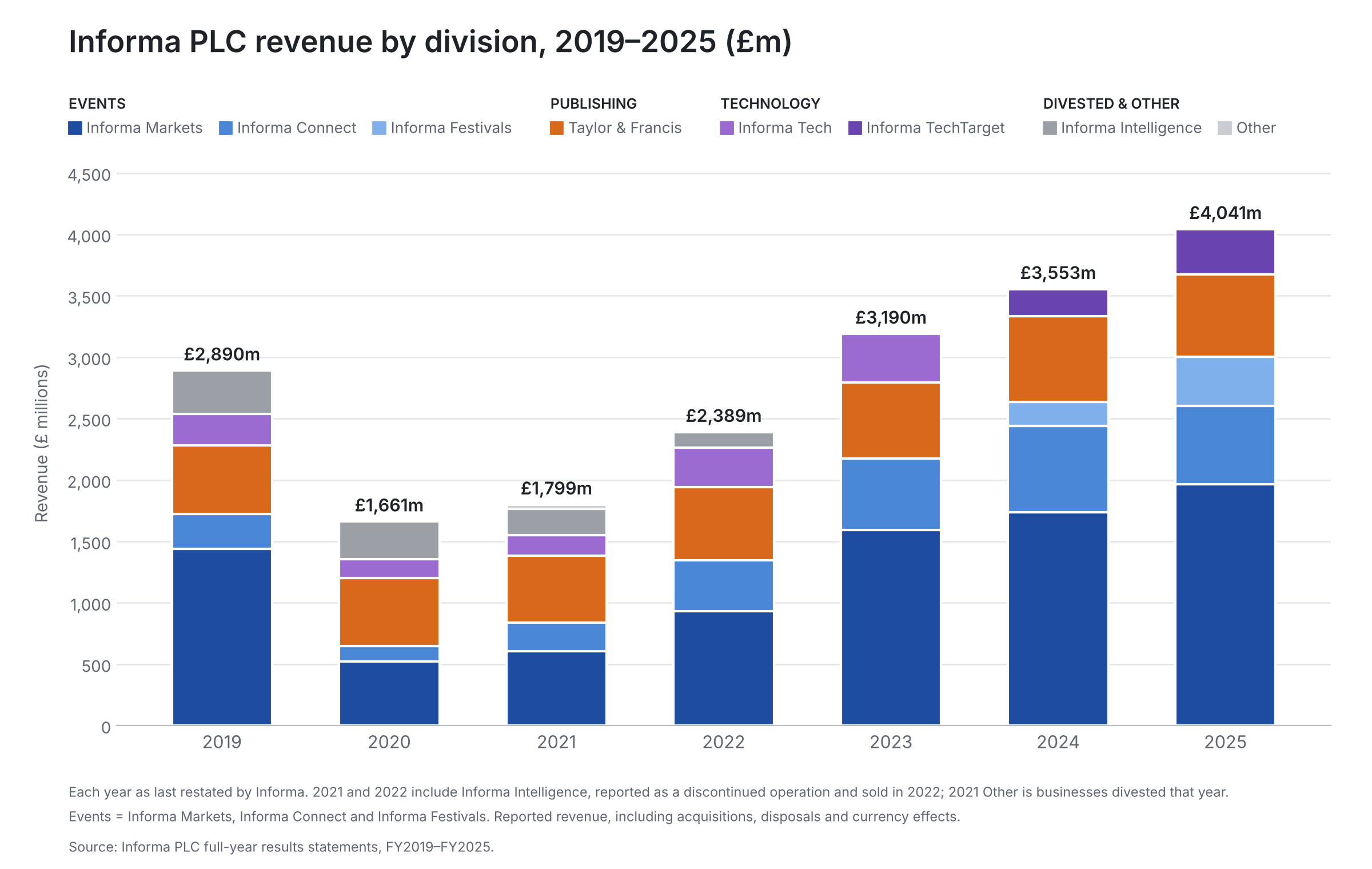
The chart shows revenues for Informa by division from 2019 to 2025. We included revenues back to 2019 as a baseline so as not to overinflate the growth rate of the events business, which would be the case if we only looked at the last 5 years. We grouped Informa’s events businesses together in blue. T&F meanwhile is indicated in orange (and Informa’s technology business appears in purple). The chart shows that Informa’s events business lines grew 74% from 2019 to 2025, from just over £1.7 billion to £3 billion. Meanwhile, T&F’s revenues have grown by 20% over the same period, from £559 million to £670 million. This is not an entirely apples-to-apples comparison as there have been some acquisitions on the events side and technology events were moved from Informa Tech into the events divisions in 2025 (we are not comparing organic growth). Nonetheless, the growth trajectories are much different for the two business areas and the impact of that divergence can be seen in the present concentration of the business as compared with 2019. In 2019, events constituted 60% of Informa’s revenues, whereas in 2025 events accounted for 74% of revenues.
T&F provided ballast during the turbulent years of the pandemic (which were particularly disruptive for live events); however, in more recent years the publishing group has acted as an anchor, weighing down Informa’s share price.
While it was likely that Informa would explore spinning out T&F eventually, the timing was undoubtedly precipitated by the planned acquisition of Clarion.
The acquisition of Clarion will further tilt Informa toward events. It is also a relatively large acquisition at £2.2 billion. Informa plans to finance the acquisition through a combination of issuing £940 million in equity, debt financing, and by pausing its share buy-back program. By announcing the spin-out of T&F at the same time, Informa helps buoy its share price. It does so in two ways:
1. Most importantly, T&F is likely to have a valuation greater than Clarion (see our discussion of the valuation of T&F below). Should they exercise the option of selling T&F, Informa would have a clear means of raising capital to quickly pay down debt associated with the purchase of Clarion. ( A spin-off to existing shareholders would not itself raise cash for Informa, but would be a benefit to shareholders).
2. It helps accelerate a reorientation of investor sentiment regarding Informa from a publishing and events business to a pure-play events business—with a commensurate lift in valuation. Investors and equity analysts often say that “everything is priced in”—meaning that an equity price reflects everything known by the market about that equity and what investors collectively expect to happen to that company. By announcing the separation of T&F, Informa has helped pull forward the “pricing in,” which in this case is to Informa’s benefit.
What Is T&F Worth?
There has been a lot of speculation about what T&F is worth. The most recent, albeit imperfect, comparable is Wiley’s recent acquisition of Emerald. Wiley paid approximately 5x revenues and around 14x EBITDA (Earnings Before Interest, Taxes, Depreciation and Amortization) for the Yorkshire publisher. With Wiley’s identification of $30 million in annual cost savings, its anticipated effective multiple was 7x EBITDA. Emerald, however, is a magnitude smaller than T&F ($85 million expected 2026 revenues as compared to T&F’s), its titles readily slot into Wiley’s portfolio, and Wiley has a clear and credible path to both reducing costs and increasing revenues.
Another relevant benchmark might be that of Springer Nature, who went public in 2024. Springer Nature currently trades at a 2.7x multiple of revenues and a 9.6x multiple of its adjusted operating profit. Valuing T&F as a direct comp to Springer Nature, one would arrive at a figure of $2.4 billion based on revenue and just over $3 billion based on EBITDA. T&F, however, might reasonably be valued at a modestly higher multiple than Springer Nature, partly as a recognition that Springer Nature is majority-owned and controlled by the Holtzbrinck Publishing Group, and partly as a function of T&F’s higher reported margin.
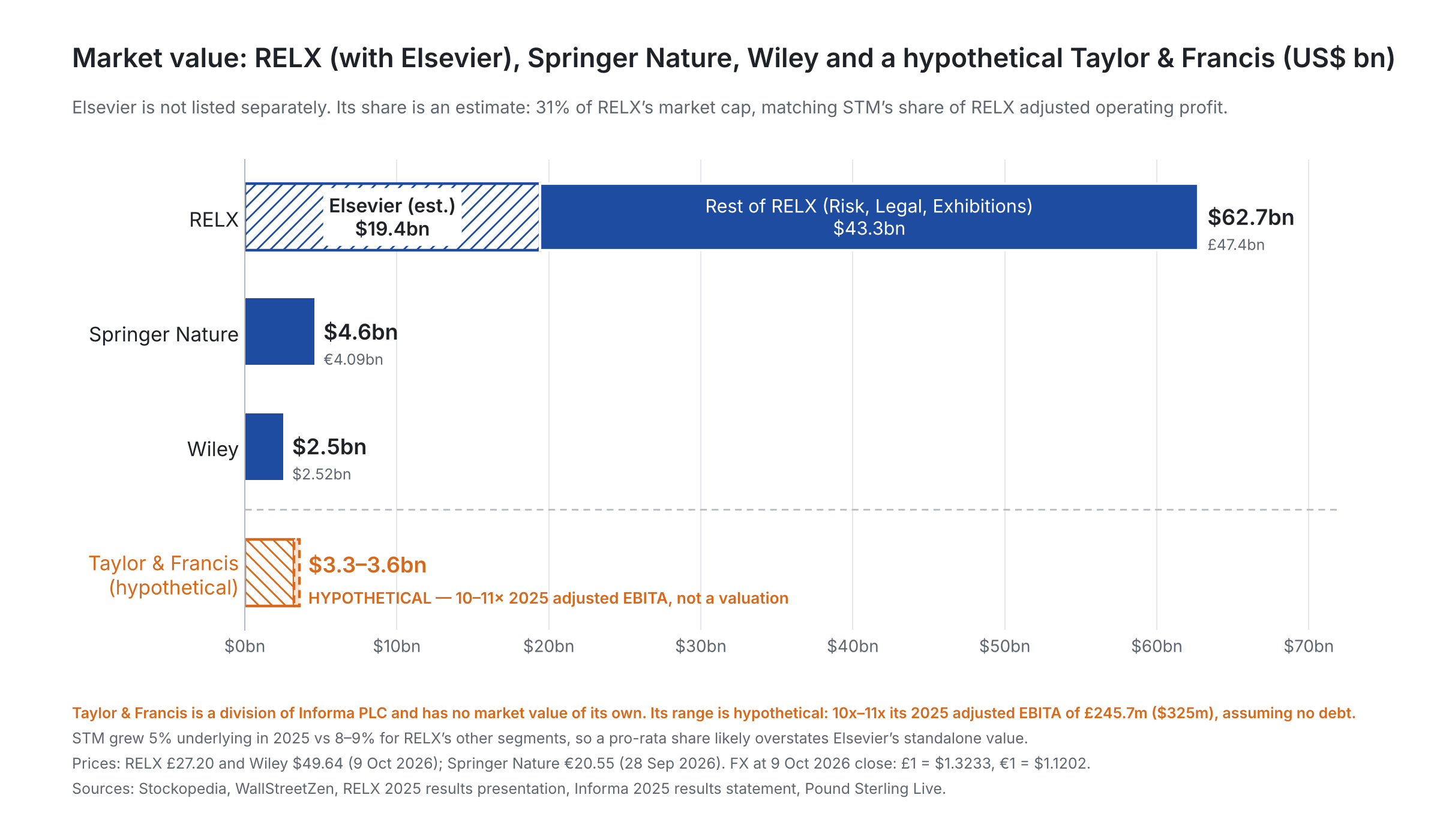
T&F’s revenue in 2025 was £670 million GBP (about $890 million USD at current currency conversion rates). While Informa does not report EBITDA for T&F, they do report “adjusted operating profit,” which is a reasonable proxy. In 2025, T&F earned £246 million GBP, which amounts to a 37% operating margin. If we use a 10x EBITDA multiple, T&F would be valued at around $3.25 billion. An 11x multiple comes to £2.7 billion or $3.6 billion USD. This also roughly coincides with the average multiple paid by private equity firms for large acquisitions. Across all sectors this multiple was 11.8 x EBITDA in 2025, per the McKinsey Global Private Markets Report. This is perhaps relevant since large private equity firms are potential acquirers, as we discuss below.
T&F’s valuation and future form will, of course, ultimately depend on the buyer and the level of market interest. (And, should T&F be spun off as a public company, its initial valuation will rest on the assessments of institutional investors.)
Who Is Likely to Buy T&F?
There was wild speculation at the Frankfurt Book Fair about who is most likely to buy T&F, with suggestions that a Chinese buyer or a tech giant will swoop in and acquire the publisher. We do not think either of these scenarios is likely. While the Chinese government is working on establishing domestic scholarly publishing capacity, they are interested primarily in establishing high-impact journals in the fields in which China is conducting the most research. Buying T&F would commit an owner to managing a large number of journals (including many society journals) in fields that China is not focused on. And it would be far cheaper (and easier) for a tech giant to just license any content it may want. Owning and operating a scholarly publisher seems like a very hard way to acquire content for an LLM. T&F is far more likely to be acquired (if it is acquired at all) by either another large publisher or by private equity.
If a publisher were to purchase T&F, the most obvious buyers are one of the three largest professional and scholarly publishers: Elsevier, Springer Nature, or Wiley. To take them in order:
Elsevier is the one publisher that could easily afford the acquisition. However, Elsevier does not need the additional heft, and buying T&F would invite a great deal of regulatory scrutiny and introduce too much deal risk.
Springer Nature could manage the acquisition though it would require taking on a lot of debt and it has been working to reduce its leverage.
Wiley combining with T&F would likely catapult Wiley to the number 2 position by revenue and market cap (though it would still be smaller than Springer Nature as measured by article output). But it would be a very large bite for Wiley. The US publisher’s total market cap is $2.5 billion, meaning it would have to take on a great deal of debt relative to its market cap. The timing for Wiley may also not be ideal given it is still in the midst of absorbing Emerald.
It is also possible that a consortium of publishers puts together a bid and, if successful, breaks up T&F, with each publisher taking a piece of the portfolio. This could fall along disciplinary boundaries (e.g., one publisher takes social sciences and humanities, another takes biomedical and life sciences) or format (one publisher could take the journals and another the books—T&F has a substantial book portfolio).
Private equity is also likely to be a strong contender. T&F is a highly profitable business with stable, recurring revenues. It is the kind of business that private equity loves, perhaps even more so at a moment when the private equity sector is retrenching following the valuation declines in software. It is possible that a single private equity firm could underwrite the deal or a consortium could team up.
The third possibility is that there is no buyer. Informa might instead spin the publisher out as a stand-alone public company. This is a distinct possibility, and it would let the public markets set a valuation. The company could always be acquired or merge in the future.
Impact on the Market
There are essentially two possible future states for T&F: Either it remains a stand-alone publisher (whether spun out as a separate public company or purchased by private equity) or it is purchased by another publisher (or publishers) and its assets are absorbed into another portfolio.
In the first scenario, T&F will continue to operate more or less as it does now. From the perspective of academic and professional societies, an independent T&F is a better option as it means there remain the same number of publishers active in the market. In the second scenario, there will be reduced competition for society journals seeking publishers. An (eventual) combined super package (e.g., Wiley + T&F or Springer Nature + T&F) would also reduce options for university libraries, tying up more budget with fewer publishers.
Informa has stated that it intends to review its options in the coming months and report on which state the future will hold by March 2027.
From Access to Storefronts
AI is changing how researchers and professionals find and use content, and publishers are finding new routes to reach them through AI platforms and applications. Direct licensing is one. C&E tracks this market closely to support our advisory work with clients, and the pool of deals is now large. Some AI companies have become repeat buyers, striking deals with many publishers. Alongside them is a long tail of companies that have each struck deals with only one or two publishers. And the buyers are varied, spanning both training and inference and ranging from answer engines and research tools to a robust category of life sciences, clinical documentation, and workflow platforms, and increasingly include developers licensing content to build agents and AI applications.
But a second route is growing alongside it: intermediaries that don’t license content for their own products, but instead sit between publishers and the AI platforms, developers, and researchers and professionals who want to access it. They come in two flavors: BYOL channels and AI content marketplaces.
Earlier this year, we wrote about the rush of MCP launches in scholarly publishing, including Wiley’s AI Gateway and Silverchair’s Discovery Bridge. These channels connect publisher content to AI tools and control who can access it. Most work on a BYOL (“bring your own license”) basis: they check each user’s existing entitlements, such as an institutional subscription, so content reaches only people who already have rights to it. BYOL models extend a publisher’s existing subscription business into the AI tools where many researchers are doing their work. Wiley reports that 60,000 researchers have signed up to their Scholar Gateway.
Silverchair is now taking the model further, piloting Research Bridge, a shared MCP channel for its publisher clients. The six-month pilot brings together a group of independent publishers (among them American Association for Cancer Research, American Diabetes Association, and Rockefeller University Press), giving AI platforms access through a single connector, with content delivered only to users entitled to it. Beyond BYOL, Silverchair also offers publishers custom licensing packages, such as content bundles for corporate pharma and aerospace R&D teams.
Research Solutions has taken a similar approach with its Article Galaxy MCP, which brings its long-running document-delivery business into AI assistants. Like other BYOL channels, it first checks what a researcher already has access to, including institutional subscriptions, library holdings, and open access. Where there’s no access, it goes a step further, offering the option to buy or rent the article on the spot.
Alongside BYOL, another model is gaining traction, which we call “AI content marketplaces.” In this model, intermediaries connect publishers with those who want to license or buy their content: AI companies, developers, agents, and, in some cases, individual researchers who pay per use. These marketplaces share the same basic structure but differ in the details: who the buyers are, how publishers are paid, and whether BYOL or training licenses are part of the mix.
There are channels for news (e.g., TollBit and Microsoft’s Publisher Content Marketplace pilot) and for books (e.g., Created by Humans). Doceree recently launched one for healthcare publishers.
Cloud data platforms offer versions for technology developers. Snowflake’s marketplace lets publishers sell content to enterprises building AI on its platform, either as AI-ready search services (used by news publishers such as AP and USA TODAY) or as datasets, like Springer Nature’s Life Sciences & Pharma Collection of more than 1,600 journals and ebooks. AWS Marketplace offers something similar, and Wiley already uses it to sell AI-ready Cochrane Library content and life sciences content to companies building AI products on AWS.
Three newer marketplaces are focused squarely on the scholarly and professional market.
Cashmere licenses publishers’ books and journals to AI products such as search engines, copilots, and enterprise agents, giving AI companies one point of access instead of hundreds of deals to negotiate. Publishers set the terms, every use is tracked and paid, and content is used only to answer queries, and training requires explicit publisher authorization. Publishers can also use Cashmere for BYOL or to power their own AI products. Since April, Springer Publishing Company, Rockefeller University Press, Princeton University Press, IOP Publishing, and De Gruyter Brill have signed on.
Redpine offers a shared marketplace of more than 20 million peer-reviewed papers. AI labs build the content into their own agents through an API, while researchers search it inside ChatGPT, Claude, and Cursor, paying per use. Publishers set their own prices, are paid each time their content is used, and receive most of the revenue. Redpine also sells larger-scale data licenses, though it hasn’t said whether publisher content is available for training. Its six launch publishers are BMJ Group, Sage, IOP Publishing, IGI Global Scientific Publishing, Wanfang Data, and RCNi.
EBSCOhost AI Exchange connects AI platforms, agents, and research tools to EBSCOhost content. AI systems retrieve content on demand, with every use tracked and paid per query, and publishers can separately license datasets for training under negotiated agreements. Publishers set the terms for both. EBSCO also offers a BYOL route for institutions through existing subscriptions. It hasn’t named participating publishers.
Pay-per-use and other granular purchasing options are at an early stage, and it’s unclear whether they will generate meaningful revenue for publishers. We also hear publishers voice concern about how they might affect traditional subscription revenue, which is one reason BYOL has been so popular. However, it’s important to remember that many of these marketplaces are built for where some believe AI is heading: agents that search, retrieve, and pay for content on their own, at the moment they need it. For publishers, the case for experimenting now may be less about near-term revenue and more about better understanding (and preparing for) emerging models.
Briefly Noted
As AI tools and agents are increasingly used to find and summarize research, there’s a lot of talk about what information should travel with each paper, and most of it centers on trust. Earlier this month in Frankfurt at the STM Conference, Ithaka S+R, NISO, and COUNTER announced the TRACE project, which stands for “Trusted Retrieval and Attribution for Content Ecosystems.” TRACE brings together “three parallel projects that address key challenges in AI-mediated scholarly communication: how AI agents discover and access content, how provenance and attribution are preserved throughout the content lifecycle, and how AI usage can be measured and reported consistently.”
OpenAlex asks whether a measure of novelty would be a useful additional indicator for an article. A UK-funded challenge produced a promising AI-based approach this year, and OpenAlex is assessing whether it should add a novelty score to every record, and what it would take for people to trust one. They are asking for input and have a survey open until November 13.
NIH isn’t spending less, but it’s issuing fewer grant awards. Grant Witness, an independent tracker built from NIH’s own award records, finds the agency issued about 11% fewer grant awards through September 24 of fiscal 2026 than its average at the same point in the previous five fiscal years. That’s the lowest count in six years, even though total dollars ran slightly above the average. The gap comes largely from NIH paying for multiyear grants up front, which spreads the same money across fewer awards. Established labs that already hold multiyear grants are mostly protected. Early-career researchers chasing their first major grant are the most exposed.
The first U.S. appeals ruling on AI training and fair use went to the content owner. The Third Circuit upheld Thomson Reuters’ win against Ross Intelligence, which used Westlaw’s editor-written case summaries to train a competing AI legal research tool. The court held that those summaries are protected even though the decisions behind them are public, and that licensing content for AI training is a real and growing market. That’s encouraging for publishers and associations, but it’s a narrow case: one company copying another’s content to build a rival product. Whether it helps in the bigger fights over generative AI is still an open question.
AI companies are making a fortune on content they mostly don’t pay for. A recent report showed OpenAI’s annualized revenue is nearing $70 billion, and unsealed filings in the New York Times case show a Microsoft executive privately calling AI scraping possibly the “largest theft of labor in human history.” Ziff Davis CEO Vivek Shah makes the obvious point: if OpenAI can plan to spend $750 billion on computing power, it can pay for the content that makes its products worth using. Google may (emphasis on “may”) be doing something about it. It is testing a program that pays publishers when their content contributes significantly to answers in AI Overviews, AI Mode, and Gemini. The program is invite-only and pays publishers based on how much Google decides their content contributes to answers, using a formula it hasn’t disclosed. The Information, as reported by The Verge, reports there are about 100 publishers in the pilot, that payouts range from under $1,000 over several months to more than $1 million a year, and that those in the pilot extend beyond news.
A new white paper from Aries Systems, From Pipeline to Platform: Submission Systems as AI Infrastructure in Scholarly Publishing, argues that submission and peer review systems (SPRSs) are critical AI infrastructure. Three reasons stand out: AI-supported workflows, trust in the scholarly record, and the value of data. First, AI is intensifying submission pressures, but it is also providing a growing range of tools to reduce administrative work. SPRSs need to integrate these tools and orchestrate how they operate within editorial workflows. Second, SPRSs are where trust in the scholarly record is established—a role that becomes more consequential as AI mediates discovery and publishers license content for AI use. Third, SPRSs hold some of a publisher’s richest data on reviewers, authors, and their manuscripts. That data is a valuable foundation for downstream AI capabilities, including personalization and advanced analytics. For many publishers, years of journal-by-journal configuration have left submission data and processes inconsistent. AI changes that trade-off: greater standardization may now deliver more value than some forms of customization. It is a rallying call for publishers to engage their SPRS partners more strategically, treating data harmonization and workflow design as decisions that shape their broader AI strategies.
The White House has decided not to issue an executive order that would subject federally funded research to political scrutiny in the face of strong opposition from both Democratic and Republican members of Congress. Congress had separately blocked a related OMB rule change until December 11 of this year—a measure we covered in August while it was still a proposal.
Last year, we covered the story of then-Interim US Attorney for the District of Columbia, Ed Martin, sending vaguely threatening letters to prominent scientific and medical journals. The letters appeared to imply that the journals were biased toward partisan perspectives in various scientific discussions, particularly related to the Covid-19 pandemic. Up until last month, only four journals were known to have been sent letters (NEJM, JAMA, CHEST, and Obstetrics & Gynecology). A freedom of information request filed by FYI Science Policy News, however, has revealed that Martin sent nearly identical letters to at least 11 journals and one news magazine (Scientific American). Martin was removed from the post shortly after the letters were sent to make way for Fox News host Jeanine Pirro.
An editor at Transactions on Machine Learning Research, an independent machine learning journal, tried something simple: before rejecting a batch of weak submissions, he asked the authors to talk him through their own papers. Most couldn’t. Some couldn’t answer basic questions, others got lost in the details, and two sent follow-up answers that read as entirely AI-written. The AIs might be learning but the humans seem to be getting dumber.
Singapore’s National Library Board is paying people to read. Its new five-year campaign, ReadSG, awards virtual coins for logging 15 minutes of reading a day. The mechanics come straight from fitness apps and loyalty programs, and governments and educators are watching to see whether those tools can make reading compete with the scroll.
***
The value of publication as a signal of researcher contribution is much weaker when authors cannot explain or defend their paper. —Nihar B. Shah, Co-Editor-in-Chief, Transactions on Machine Learning Research.