



Job Opportunity: Chief Marketing and Communications Officer, American Physical Society
We’re proud to be partnering with the American Physical Society (APS) on the search for its next Chief Marketing and Communications Officer. This is a unique opportunity to shape how this globally respected scientific organization communicates, engages, and grows its impact worldwide.
The CMO will lead a high-performing team, support revenue growth, and steward how APS communicates its mission and work in physics. The role oversees all marketing, external and internal communications, media relations, and related digital strategy, and plays a central role in engaging diverse audiences and strengthening relationships with APS members, authors, and customers.
Remote-first in the U.S. with executive compensation.
Colleen Featured in Wiley’s The Conversations: Navigating the Future of Scholarly Societies
Colleen recently joined Wiley for an episode of The Conversations to explore how scholarly societies can navigate an increasingly competitive landscape. The discussion covered the strategic challenges society leaders face today, including revenue diversification, research integrity, modernizing marketing and technology, and making strategic build-versus-partner decisions. Panelists included Colleen Scollans (Clarke & Esposito), Steve Echard (American College of Rheumatology), and Miriam Maus (IOP Publishing) — moderated by Jay Flynn (Wiley).
C&E Is Hiring!
Bucking the trend of reducing staff, C&E is hiring. If someone you know (or perhaps yourself) is interested in working with a talented group of colleagues and a truly extraordinary roster of clients, we want to hear from you. We welcome applications from a wide range of backgrounds.
Marketing Coordinator: This exciting role has two dimensions: 1) Support C&E marketing — from brand positioning and content strategy to marketing operations, campaigns, and digital optimization. 2) Provide support on consulting projects in the Marketing & Digital practice.
Plunge
The equity markets have not been kind to scholarly and professional publishers over the last 12 months. Collectively, the publicly traded professional publishers have lost over $50 billion in equity value. The value of Wiley stock is down nearly 30%. Springer Nature stock is down 35%. RELX (the parent company of Elsevier) stock is down 39% over the same period, despite stock buybacks. Wolters Kluwer stock has declined by a truly stunning 54% — the venerable Dutch publisher is worth less than half what it was a year ago. The only publicly traded professional publisher to buck this dismal trend is Informa (parent company of Taylor & Francis), whose stock is down only 4%.
The period we looked at for all equity prices was February 2, 2025 – February 2, 2026. Most of the decline has been in the last 6 months – with the last week being especially grim as we discuss below.
Nearly all of these companies have business lines beyond scholarly and professional publishing that materially factor into these stock losses. So the stock price of most of these companies is not necessarily the market’s assessment of their scholarly publishing activities. That said, Springer Nature is pretty much a pure-play scholarly and professional publisher, and its stock performance was in the middle of this pack.
It is a particularly disheartening barometer given the wider S&P Index is up 15% during this same time period; factoring out the Magnificent Seven (Alphabet, Amazon, Apple, Meta, Microsoft, Nvidia, Tesla), the S&P is still up 12%. Even Informa, the stand-out performer in this cohort, still substantially trailed the S&P.
It is tempting to chalk this lamentable performance up to geopolitics. The current US administration’s policies related to research funding agencies and university grants are certainly not helping matters. And the growing reliance on papers from China by many publishers has raised risk profiles given the Chinese government’s intentions of building domestic publishing capacity. But neither “US policies” nor “too many papers from China” explains such a steep decline in market value. Other industries are even more affected by US policies (any industry impacted by US tariffs, for example). And recent US developments (increasing the NIH budget and blocking reductions in grant overheads that go to universities — see below) have worked in publishers’ favor (or at least not to their detriment). The development of a world-class Chinese scientific publishing industry is certainly a real risk. However, this will likely take many years to reach maturity, and in any event, a reliance on Chinese papers fails to explain the stock performance of Wolters Kluwer, which has a relatively small and concentrated medical publishing division with the least exposure to China of the major commercial publishers.
The more likely culprit behind the sector’s market performance appears to be “AI risk.” One relevant data point is the valuation of OpenEvidence, an AI medical information platform (or “chatbot for doctors”). OpenEvidence recently closed a $250 million funding round which valued the company at $12 billion. You read that correctly: $12 billion. That valuation means that OpenEvidence, a company founded less than 4 years ago, is presently valued at more than double Wiley and Springer Nature combined. It is not inconceivable, if current trend lines continue, that in less than a year’s time it will be worth more than Informa or even Wolters Kluwer. Of course public market valuations and venture-backed private market valuations are very different things. Nonetheless, this is a bonkers scenario.
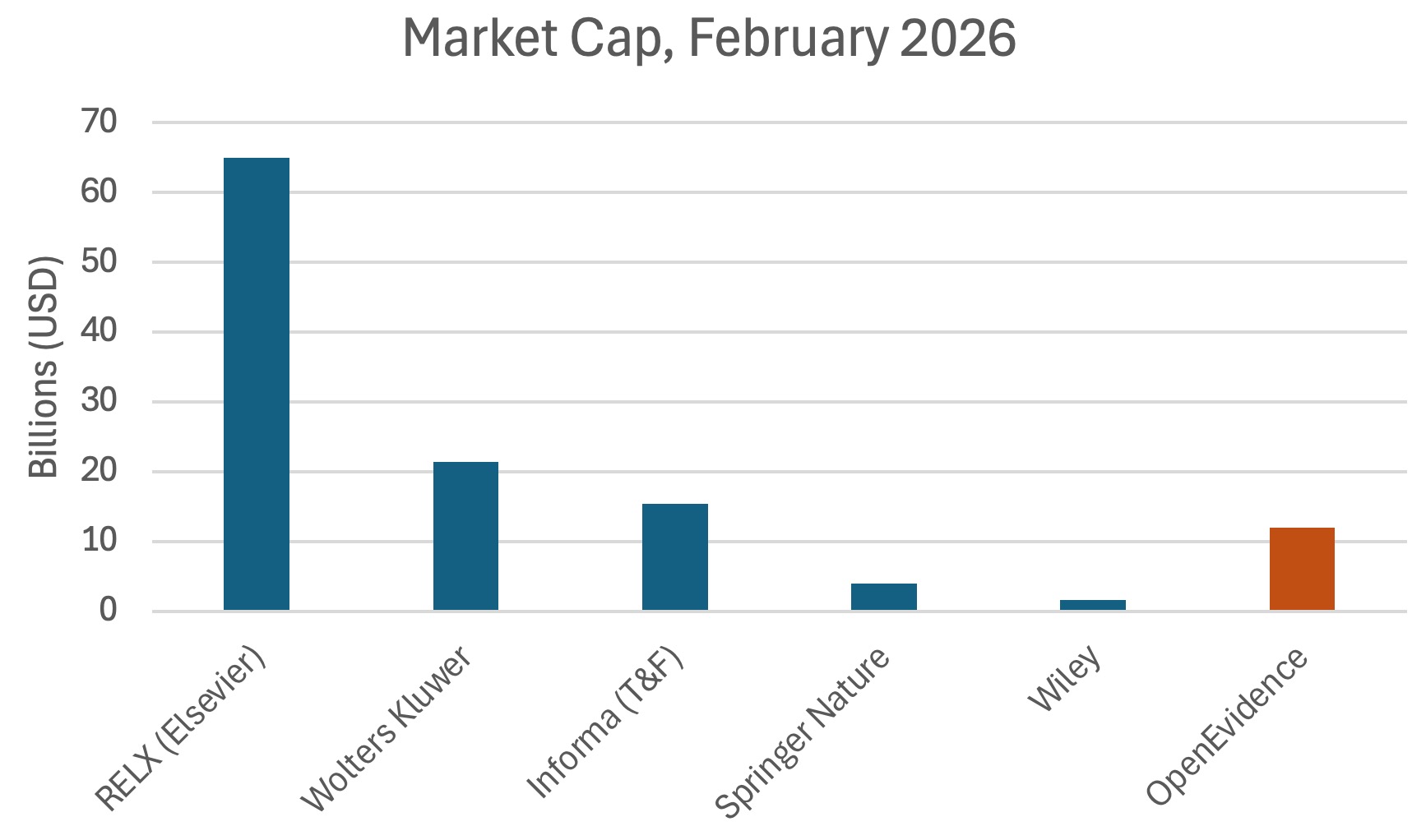
Note: Data was drawn from Yahoo Finance and Euronext. OpenEvidence’s valuation is not a market cap (which largely applies to publicly traded companies) but is a private market valuation. We included it here, even though it is a bit apples-to-oranges to provide directional comparison only.
We do not mean to suggest that that the rise of OpenEvidence is directly related to the stock value declines across the professional publishing sector. It is possible that the success of OpenEvidence has contributed to the decline in equity value of Wolters Kluwer, whose UpToDate product has the most to lose from the upstart. But OpenEvidence is not directly competitive with any of the other publishers. Indeed, they may stand to benefit from licensing deals with the AI company.
“AI risk” is, of course, much broader than OpenEvidence (a relatively small AI company as compared to the giants building foundational models). According to reporting in The Wall Street Journal, part of the drop in share price at RELX and Wolters Kluwer is related to the roll out of new functionality for legal teams in Anthropic’s Claude Cowork product. The fact that both of these companies (Wolters Kluwer and RELX) have AI products in their legal and clinical divisions does not seem to have changed the trajectory of their stock price. Indeed, it seems to be counting against them. An article by Reuters quotes a senior investment analyst at Danske Bank, noting that makers of legal software products (including RELX and Wolters Kluwer):
…were assumed to be winners from AI… but all of a sudden, you start to worry about whether you can earn the money back (from your AI investments), and/or will you be outsmarted by updates coming in.
In other words, some investors are questioning whether professional publishers and other makers of industry-specific AI software can compete with tech giants that are increasingly stepping on their toes. Another relevant example from just the last month is the launch of Prism by OpenAI — although not a direct competitor to Elsevier’s LeapSpace (also just launched), it is uncomfortably close.
Why does any of this matter to anyone except investors and staff at these companies with bonus structures tied to equity? We would argue it matters because when a company’s stock price falls by 30%–55% absent a wider macroeconomic downturn to pin it on, investors ask some hard but predictable questions of management, along the lines of What are you going to do about this? (We do not envy the incoming CEO of Wolters Kluwer, Stacey Caywood, who takes the helm later this month following a 23-year run by Nancy McKinstry. Being asked what you are going to do about a 54% drop in your share price is a bracing way to start the job.)
CEOs like to be seen doing something generally, and especially when investors are clamoring. Things CEOs typically do in such situations include buying back stock, reducing costs, buying things, and selling things. We anticipate seeing all of the above in the coming months — which could have implications for society partners.
Reductions in headcounts or other cost-cutting measures may impact service levels. Acquisitions and divestitures may redirect focus (and resources) — or may even result in further consolidation.
We also anticipate seeing adjustments to AI strategy, which are already a factor in society publishing partner selection decisions. In clinical medicine, where society and publisher interests are starting (in some cases) to diverge, societies are seeing extensive interest in licensing whereas some publishers are expressing caution out of concern for their own product lines. This is causing tension and may lead to more switching of horses at the end of contracts than usual. Publisher AI strategies may diverge further in the coming months as companies attempt to reassure investors.
For those who either work for a publicly traded professional publisher or do business with one in one way or another (which we imagine are most readers of The Brief), 2026 is shaping up to be a roller coaster. We anticipate reviewing far more press releases than usual in the coming months.
Briefly Noted
The US Congress appears poised to soundly reject the White House’s proposed 40% cut to the budget of the National Institutes of Health (NIH). A final bipartisan spending bill has instead increased the agency’s budget by $415 million over FY 2025. In addition, the bill’s language prohibits the agency from cutting institutional overhead rates. Assuming this passes the full House and is signed by the President (both of which are anticipated to occur this week), it will be some much-needed good news for (among others) scientific publishers. The drastic reductions in grant overheads proposed by the administration have been blocked by courts — including as recently as last month, when an appeals court upheld a lower court’s injunction against the caps. Now the injunction will have not only court opinion but the force of explicit legislation. Had the administration succeeded in capping overheads at 15%, it would have impacted already strained library budgets, likely triggering subscription cancellations at many research institutions.
A proposed class-action antitrust lawsuit filed by four researchers accusing major academic publishers of illegally restricting competition by not allowing submission of papers to multiple journals simultaneously and not paying for peer review was tossed out by a federal judge in New York, who ruled the plaintiffs hadn’t shown evidence of a conspiracy.
Rick Anderson revisits a touchstone article he wrote a decade ago on the “quiet culture war” in research libraries. Rick’s original observation was that:
there was growing conflict within the academic library profession between, on the one hand, those who see “the research library’s most fundamental and important mission as serving the scholarly needs of its institution’s students, scholars and researchers,” and, on the other, those for whom “the research library’s most fundamental and important mission (is) changing the world of scholarly communication for the better.”
According to Rick, this culture war has only deepened, with the open access movement being the prime example.
Association of Computing Machinery has announced that its 5-year transition to open access has been completed and “all ACM publications and related artifacts in the ACM Digital Library have been made open access.” We were skeptical ACM would be able to pull this off — kudos!
STM and Research Consulting have released a new report: Safeguarding Scholarly Communication: Publisher Practices to Uphold Research Integrity. The report documents state-of-the-art practices and industry initiatives underway to combat paper mills and other fraudulent practices.
The thing about combatting paper mills and other fraudulent research practices is that you have to actually want to do it. Cabells reports that their Predatory Reports Database now includes 20,000 deceptive journals. Presumably the publishers of these titles did not participate in writing the Safeguarding Scholarly Communication report.
Speaking of dubious research practices, how is it possible we are still dealing with the problems with special issues?
Cell Press has entered the megajournal business with launch of Cell Press Blue, which publishes across life, physical, medical, sustainability, and applied sciences.
Environmental Health Perspectives (EHP), established by the National Institute of Environmental Health Sciences (of the National Institutes of Health) in 1972, has been donated by NIH to ACS Publications via the Federal Surplus Personal Property Donation Program.
We have Slow Food, Slow Fashion, and now Slow Science.
Jonathan Woahn, a co-founder of Cashmere, published a two-part article in The Scholarly Kitchen arguing that AI “training” licenses will not become a durable revenue stream for publishers. Instead, he argues that publishers will need to develop inference-based (or query-based) revenue models for licensing. We agree! (as does Wiley) — although that does not mean there is not significant one-time revenue to be made from training licenses. He further posits that publishing “is in the turbulent middle of a reallocation” of revenue from old models to emerging models. While this remains to be seen (we are not aware of institutional licensing revenues declining across the sector which seems a prerequisite for reallocation), it has become abundantly clear (see lead article above) that reckoning with AI has become an existential priority for publishers.
In other Cashmere news, the start-up announced it has secured a $5 million seed round of funding.
McGraw-Hill announces CEO succession plan.
BMJ Group appoints Niels Peter Thomas as CEO, BMJ Publishing.
The Best Name for a Clinical Trial in 2026 (so far) award goes to — the DECAF trial.
Every once in a while, something important slips through our information collection net. While it seems the entire world has been focused on AI, a Cambridge researcher quietly released a software package that creates LaTeX coffee stains:
This package provides an essential feature to LaTeX that has been missing for too long. It adds a coffee stain to your documents. A lot of time can be saved by printing stains directly on the page rather than adding them manually. You can choose from four different stain types.
***
The fundamental error of the OA movement, from the beginning, has been the wishful belief that as long as a publishing model is desirable and equitable, it must therefore be both attainable and sustainable. —Rick Anderson